Grown Without Schooling
By Peter Kowalke
An adult unschooler interviews his peers to find out what they are doing and thinking now.
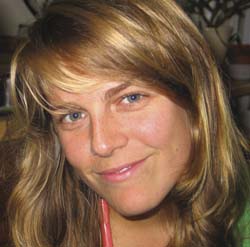
Chatting with . . . Selina Hunt, Age 26
Fresh from College
I just finished college last year, and currently I’m working at a design firm in Union Square. My training is as an industrial designer, but I’m working on an exhibit design project. It is a really great project because I’m working with graphic designers, researchers and content developers to pull together a museum on Wall Street about American finance. It will open in October.
Industrial design is really broad. Some people go into transportation design, some people design furniture, others design consumer electronics like cell phones and blenders.
While I was at school I really concentrated on furniture and lighting, and I did some packaging work. I really liked packaging because it was a combination of graphics and more structural, three-dimensional work.
The packaging work helped me transition into exhibit design because we’re considering the lighting, the case work and the fixtures that will actually display artifacts, but we also have to integrate them with the graphics and the way-finding information for visitors. It is like packaging design a bit, just on a much grander scale.
Swimming Upstream
Originally, I was of the mind that I really didn’t want to go to college because I didn’t know what I wanted to study. I didn’t want to go just to go; it didn’t seem like the right path. So instead, I took four years off. I did a couple of internships, I worked full-time for a while and saved up money, I traveled. It wasn’t until I was 20 that I went to college. (I “graduated” homeschooling when I was 15.) I think those four years were definitely important. They let me follow my interests and just get a little more grounded.
There definitely was a lot of societal pressure to attend college. I had people asking me everywhere I went, and everyone I met asked me why I wasn’t going. I got fairly defensive about my choice, and I really felt that I had to prove that what I was doing was valid even if it was an internship. I came across a lot of people who thought that because I wasn’t going now, I wouldn’t ever go. There also were people who wondered if I could handle college because I had homeschooled.
I think I drew strength from my homeschooling experience during the pressure to attend college. I was home- schooled all the way through, and it was always the case when I would meet people that I’d have to explain why I wasn’t in school. I always had a set of answers to give, and I always had to defend where I was and what I was doing. So when people would ask why I hadn’t decided to go onto college, I felt pretty accustomed to defending my choices.
The Allure of Gold Stars
I feel like I have to prove homeschooling, even to this day. Generally people have a pretty positive impression of homeschooling. Even so, I do feel it is something I have to prove.
The feeling that I needed to prove myself in college made me really push myself academically. I never had been given grades before, and getting good grades became very important for me. It actually was kind of scary. I didn’t like myself when it came to really wanting to excel; it really took hold of me.
Until college, which was my first structured academic setting, I had just pursued things because I was interested in them. There never was any system of rewards or punishment. But when I got to college and continued as I had been, following my interests, I discovered that if I really put in extra hours and over- achieved on certain projects, I would be really appreciated. I just really soaked that up.
I could definitely feel myself getting addicted to the gold stars. I kind of wanted to hold myself back and resist that, but I was very much allured by it. Luckily, I loved what I was doing and it wasn’t just about the grades.
Discovering Sustained Community
A positive side of the more structured environment of college was the interaction with my peers in class. That was something I really appreciated, getting all the critique and feedback from my classmates.
At times it could be frustrating, because rather than just a one-on-one situation where I got my teacher’s feedback, our group was talking about 25 projects. Four hours later, you’re falling asleep in your chair. So at times it could get frustrating.
But for the most part, that was a really positive thing – to be given the same assignment, and to see where all these other people took it, to watch their processes. It was different from my homeschooling experience. I saw the way my brother learned, and I was involved in classes here and there, so I was not in an isolated situation by any means. I never had the contact on a daily basis for four years, though. In many cases I spent the entire year with the same group during college, and having that continuity and group dynamic was really a big difference for me.
I don’t think, “Gosh, if I had gone to school I would have had this all along!” It was nothing like that. But, it was an added benefit of college.
Unschooler Dating
It is interesting to be dating someone I consider to be almost a homeschooler. Zack shares a lot of the values I do, and he is the closest thing to an unschooler that he could be. But he went through the system. He didn’t have the best experience in school by any means, so maybe as a result of that he shares a lot of my values when it comes to education.
More than interesting, it makes sense. A lot of homeschoolers are drawn to each other because there’s a commonality; a lot of us are coming from the same place. So, it is fitting that I would be drawn to someone like that. I have dated people who have been far more mainstream, and it has worked all right. But I missed that shared experience. Like most people, I’m looking for similar thoughts and values in a partner. As a homeschooler, though, there is a diminished number of people out there who would be right for me.
My partner doesn’t have to be an unschooler, but I do need someone with those same unschooler qualities.
Peter Kowalke grew without schooling. He is a journalist and the producer of “Grown Without Schooling,” a documentary about grown homeschoolers and the lasting influence of home education. This article was published in 2007.
Copyright © Life Media
Privacy Policy
  
|
