What Really MattersA Conversation About Workbooks Between David Albert and Joyce Reed
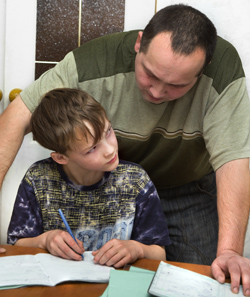
Photo © Larisa Lofitskaya / Shutterstock David: A homeschooling mom reported that her 11-year old son, who is “a hands-on kind of guy interested in cars and motors,” couldn’t be goaded to do the required pages in the math workbook. “He’s just not motivated to learn,” she wrote, and then asked, “How do you make boring math worksheets fun?” There was the familiar inward groan in my nether regions, the gorge rose in my throat and I, “Mr. Homeschooling Know-It-All” that I sometime masquerade as, was about to go for the jugular. “Why would you want to deceive him?” almost poured forth from my fingertips (this was an e-mail conversation), “Math worksheets ARE boring. Why confuse him into thinking otherwise?” I managed to restrain myself just in the nick of time, bit my tongue (actually, the tips of my fingers) and felt virtuous for the rest of the day. Boring is in the eye of the beholder. I have friends who are accountants, and happy ones at that. They take pride in the books balancing, and are quite willing to spend days, weeks, or even months to gain that satisfaction which comes with a job well done. They have wives and husbands and sons and daughters, and are involved in their families, churches, and communities. I can’t imagine it for myself, but then most of them get paid more than I do. My wife balances the checkbook. And my younger daughter now thinks she wants to be a CPA! But, hey, at age 11, I would sit for hours alone in my room with my stamp collection – two huge volumes, with more than 35,000 stamps. And I would count them! (would you believe?) I engaged in a census twice a year. How boring is that! The side benefit, unbeknownst to me at the time, was that I became an expert, relatively speaking, in the historical geography and emerging nations of mid-to-late 20th Century Africa, and the changing geopolitical face of Europe during World War I. To this day I can regale you with the transformation of Upper Volta into Burkina Faso (in the 1920s, “Haute Volta” was overprinted on stamps from Upper Senegal and Niger; it became the “Republique de Haute Volta (replete with new stamps) in 1960; it metamorphosed into Burkina Faso -“Land of the Incorruptible Men” in 1984, – but for 11 days, from August 4th to August 15th, 1984, it was spelled “Bourkina-Fasso”, though I don’t know if any stamps were sold in this period; the first “Burkina Faso” stamps were from November 1984. What would a Name-Change Day first-day cover, with the old spelling, be worth? And would it even exist?) (What is this man talking about it?) If you are not snoring yet, let me tell you about Bosnia-Herzegovina stamps from 1915, or, if you allow me, we can discuss the stamps issued by the Sultan (whatever happened to him?) in pre-Independence, pre-Tanzanian Zanzibar. Having a good snooze? I expect many of you are ready to cry “uncle”, but those with similar fascinations should come see me at the next homeschooling conference and we can form a support group to extol the relative philatelic virtues of San Marino or the Malagasy Republic. Anyhow, my next thought was to inquire whether Mrs. Homeschooling Mom found math workbooks boring. If not, was she working through any herself? I know lots of folks who seem to have inherited a love of crossword puzzles from their parents, even if they don’t do anything for me. Chances are if you want your kids to become interested in baking pies, you should bake some pies (and have them turn out reasonably decent). Or not. My brother-in-law became an excellent gourmet cook, apparently because, at age ten, he grew tired of leftovers and TV dinners. (“We made crepes…all over the kitchen!” adds my wife.) In my household, there was very little time while the kids were growing up that at least one of us, my wife Ellen or myself, weren’t learning something in a formal setting. My wife went to massage school (and got to practice on the kids); and later spent three years working toward a nursing degree. When I wasn’t learning about public health for my professional work, I was often studying music – both Indian and western instruments or opera – and, at least with the first, would often travel long distances for lessons. Practicing came with the territory. We defined ourselves as a learning family, and even put a sign on the house. Of all the things we did to help our kids as they embarked upon their learning adventures, having them watch us learn would rank up there among the top three that propelled them along. But as John Holt so cogently argued in What Do I Do Monday?, chances are that if the project, in this case the workbook, doesn’t interest you, you shouldn’t imagine that you can make it exciting for your children. Might happen because of the child’s own interest, but it’s not likely to have anything do with you. You could beat or browbeat or bribe him. Three sides of the same coin (like that one!) Oh, but that’s not fair: for most kids, beating or browbeating wouldn’t make boring workbooks fun, which is what Homeschooling Mom requested. (It might actually make him learn, but there would be other consequences, such as associating learning with physical or mental trauma. Or even worse – perhaps he would learn to like the beatings. Let’s agree not go there.) But while my mind is veering off in all directions (no, I don’t need any meds adjusted, let me tell you about our two dogs and my wife. Ellen lets the canines out for brief periods in the backyard to accomplish “nature’s calling” (who coined that expression?) and then “invites” them back in. The big one – Gracie, half-Airedale/half-German Shepherd and getting on in dog years – doesn’t require any special enticements. We think of her as “dumb” – actually, from a canine point of view, she may be Einstein, for Gracie has figured out how to get everything she really requires – food, water, a daily walk, and an occasional pat on the head – through the absolute minimum expenditure of energy. No fetch, roll over, play dead for her. “Wag your tail” is about as close as Gracie gets, and only when she isn’t sleeping. But the other one – a jet-propelled West Highland White Terrier named Duncan – has an occasional habit of staying out too long for my wife’s liking. And so one day, Ellen yelled “Treat” and wagged a dog biscuit his way. She did this enough times so that now, if anyone tries to call the little ragged furball back in, he often leisurely stretches himself out on all fours, and pointedly ignores you if he chooses, until the treat is announced. And, sometimes, even that doesn’t work, as – I think – Duncan does a mental calculation regarding the value of the treat relative to his immediate enjoyment of sunning himself on the grass. The big dog, already inside and lying down, sidles over to get her share. They’ve both matured, and have us all well trained, and bribery has succumbed to the law of unintended consequences. Behaviorism may be fine for pigeons or laboratory rats (even then, I’m unsure), but learning among the higher mammalians – dogs and children – can at least sometimes be a little more complicated. The problem with all behaviorist approaches, even if or when they “work”, is that they have to ignore or at least play down their impact on a being’s inner life, or, ultimately, deny that an inner life even exists. So, now I’ve gotten you to read about my stamp collection, learn about the sign on the front of the house, and contemplate my dogs’ inner selves, and you’re still here. Amazing! But I still haven’t explained much about how the math workbooks could be fun. Do you have a sense I’m evading the question? Well, for some kids, you could turn the workbooks pages into games. If your child is a competitive sort, you could time the pages, and even graph the results, with a penalty for every hoop left unjumped, as they do in dog agility competitions. (What’s with this dog business today?) I can remember a time when my older daughter Aliyah had a workbook of “mental math” problems that she would take in the car, with the object being to build up speed. It was actually very effective. I can’t imagine, though, that many kids would want to keep playing games attached to workbook pages for very long, or more than intermittently, though there are dozens of books filled with fun math games on the market. It could also be that it isn’t the workbook pages themselves that are “boring” but the setting or expectations about “deportment” about how they are to be done that make them so. Some people think better, and perform better, and feel better about what they are doing when they are standing up or walking, humming, have the TV on for background noise, listening to music through earphones, eating, chewing gum, or (rather rarer I would think) standing on their heads. Lest you think this strange, I would note that in the library world’s “holy of holies,” the Coddrington Library at All Soul’s College at Oxford University, there are no chairs and no tables, just lecterns at which scholars may stand, and corridors down which they can walk while they read. My newly hired “quantitative” assistant has his desk mounted at four-and-half feet high, and stands most of the day while he’s working, and his numbers and graphs look fine to me! (Haven’t asked him about workbooks, though.) Another “fun” way to have some kids do math workbook pages is just to leave a bunch of said workbooks around the house. Make sure they cover multiple subject areas, and multiple grade levels (what “grade level” is supposed to mean is a subject for yet another discussion.) You’ll probably find that each of the kids won’t do any for a period of weeks and months, only to have them zip through pages and pages of them at one sitting at some other time. All of a sudden they’ll be coming to you with questions you would never have expected them to be asking. This won’t help with the conundrum of having your child enjoy the math worksheets on a daily basis, but that wasn’t really the point, was it? I assume, I hope correctly, that the point of making workbook pages fun was so that the child would learn the math. I can detail dozens of methods of learning math that don’t entail workbooks (and have actually done so elsewhere.) But suffice it to say that most of the math that is ever needed in one’s life (and a lot more!) can be learned through grocery shopping, and most parents would agree that this is one of those life skills the kids can’t do without. Grocery shopping has an additional advantage in that children want to learn it simply because, unlike the workbook pages, it is something they see adults do. Grocery shopping is “grownup;” workbook pages not. (The alternative, as already suggested, is to have adults around them doing workbook pages.) If parents were to spend as much concentrated time grocery shopping with their kids, and conceived of it as an ‘educational adventure’, I’m convinced that most of the need for the workbooks, at least in the kids’ first decade, would simply fade away. “Educational publishers” are not going to like me. What else is new? But, all right, maybe not all learning is fun, or can be fun all the time. I don’t especially like to go to the dentist either, but I like to be able to chew. Sometimes the motivation has to come from the reality that particular kinds of learning are instrumental to other more desirable outcomes, activities, or even other learning adventures. This in itself is a very important lesson, but once you conceive of it as such, it has to be approached with care. Simply telling your child that the boring workbook pages are “good for you,” or “you’ll thank me later” simply doesn’t cut it. The trick, if there is one, lies in enabling a child to see for herself that learning can be instrumental in getting her to a place she wants to go. This is going to be different for every child. Some glom on to learning goals very early. For reasons that I do not really understand to this day except that it was related in some way to her great love of nature, at a relatively early age (10 or 11) my older daughter Aliyah decided she wanted to pursue high school chemistry. We told her that we thought she would need quite a bit more math to take it on successfully, but we bought her a textbook (returnable!) and gave it to her to look through for a couple of days. She quickly came to the conclusion herself that she could not really move forward without substantially more math, and we first explored and then carved out a plan together whereby she could get herself to a position where could accomplish what she desired. The plan included a computer-based curricula, and an occasional workbook, neither particularly exciting or engaging, and within about two years, she was ready to enroll in college chemistry at the community college. An exception? Yes, but mostly in that she was able to articulate a learning goal so well, that we were willing to engage it, and together we were able to formulate a plan by which she could reach for it. She had already incorporated from learning the violin that getting where she wanted to go required time, energy, and effort. (In short, learning music was every bit as important to Aliyah’s future success in her chemistry quest as the math was, and likely more so.) If early in their lives, you get used to listening for and engaging your child’s passions – academic or otherwise - and working with them to set goals for themselves, the struggles around the boring workbook pages more often than not fade away, or at least you are less likely to feel they are worth having! So, now, what was it we were talking about? Ah, yes, workbooks. Got to try to stay on point, or at least somewhere in the vicinity. How about chucking ‘em for awhile and paying attention to what the dear boy is interested in, namely, cars and motors? Homeschooling Mom may think she can’t be much help with these herself, but she’s in luck, because on this great continent, there are literally millions of people who share this infatuation. In towns and cities across America, there are car clubs for everything from Model Ts to Mustangs, folks tinkering in backyards and garages, hundreds of thousands of them ready and willing and excited about sharing their passions, and precious few kids to share them with. And they’re all a phone call, or an uncle, away! Many people are reluctant about trying to find this kind of mentoring opportunity for their kids. And indeed, sometimes finding just the right one isn’t easy. So who said it was supposed to be easy? But instead of thinking of it as imposing on people, conceive of it as rebuilding community. You are performing a public service by enriching a community of passionate teachers and passionate learners that school-based education has left impoverished. Who knows? Her son may end up dreaming about, and eventually building, the first really viable hydrogen-powered car! Or maybe he’ll be a dependable auto mechanic, the only one in the neighborhood. Or maybe a General Motors executive. Or a restorer of classic cars. Or maybe none of the above. He might decide that once the passion for motors has run its course, he wants to become a mathematician, some place where he can be certain he’ll never have to look at a math workbook ever again. Sooner or later, pleasing mom is no longer going to be sufficient motivation, for anything. It may happen at 8, or 11, or 17, or 46, but eventually, the motivation to learn, and to allow the spark to ignite has to come from within rather than from without. And maybe, at some point, we can envision our main job to be adding fuel to the flame. Perhaps we might start with workbook pages for good kindling… * * * * *Joyce: Dear David – I loved the part about your stamp collection (of course!) But what a rare breed of child you would be in these days! I can hardly imagine. I have a grandson who collects little dragon replicas (dragons are popular in children’s literature), but. . . stamps? Nowadays, they are, I think, a very rare item in most youngsters’ realm of experience - as, in fact, is snail mail. Kids know about email, Instant Messaging, texting, and junk mail – oh, and packages from doting grandmothers like me, or from countless mail order companies (make that online orders, not ‘mail’ mail) -- though come to think of it, my parcels and most packages come via an expedited carrier like UPS or FedEx, so that the item is trackable. Regular mail is ‘not reliable’. If parcels do come through the postal service, the shipping cost is put on with a metered machine. So frankly, kids don’t use and hardly ever see stamps. I know that’s not quite true – there are Christmas cards, and birth announcements, and wedding invitations, but kids don’t send them. Indeed, you were (and are) very special, David. Where is your stamp collection these days? Okay, so what about the workbooks? Not only boring, but utterly archaic. Unless your inquiring Mom and son are living totally off the grid without electricity at all (as my homeschooling family and I did were ten years [not even a radio] back in a pre-historic experience of the 1970s), her child’s (almost any child’s) expectations have been, shall we say, altered by television and computers. Slightly. Significantly. Irrevocably. The good news is that Mom could now discover a wealth of dynamic and attractive computer-based online learning opportunities that could accomplish what the workbooks promised, and much more. Some programs may still be boring, I believe, but others are quick and attractive, are interactive and may have access to personal tutors. In any case, I am sure she will find it more advantageous, to her and her son, if she ‘gets real’ and begin to explore today’s (and tomorrow’s) possibilities. Kids seem to be different these days. We all see it. They multi-task automatically, and they learn visually and experientially. (Honestly, maybe kids were always that way, but schooling/teaching certainly was not!) In any case, one of the best pieces of advice I have ever heard (regarding anything) is to ‘Be Here Now’. Workbooks are not where now is at these days, so it’s time to get real. And by the way, I totally agree with the principle of learning arithmetic/basic math in the grocery store. That’s where my five kids/now college grads got their first lessons – the grocery and the hardware stores, and the seed catalog. So whether your Mom and her son leap into the arms of technology or slip into the comfort of the tried-and-true experiential learning (shopping), in either case I do suggest – get real. That is all that really matters. David Albert is a homeschooling father, writer and speaker. He is the author of a number of books, including And the Skylark Sings with Me, Homeschooling and the Voyage of Self-Discovery and Have Fun. Learn Stuff. Grow. Homeschooling and the Curriculum of Love. He lives, works and writes in Olympia, Washington. Joyce Reed is the parent of five successful home educated college grads. She served for 14 years as Associate Dean of The College at Brown University where she reached out to homeschooled teens. After retiring, she began consulting with primarily international and homeschooling families seeking to attend college. This article is included in the book What Really Matters by David Albert and Joyce Reed. |
|
|